
By Mehari Worku
The Middle Eastern Languages and Cultures Department works closely with other departments, programs, and centers at UW to promote knowledge of the Middle East and new ways to study it. In this article, learn about MELC’s collaboration with the Translation Studies Hub (link: Home | UW Translation Studies Hub)—which is scheduled to migrate to MELC soon—and with the Middle East Center (link: Middle East Center - The Henry M. Jackson School of International Studies).
Translation Studies
The Translation Studies Hub has been an important contributor at UW since 2019, recently originating its own undergraduate minor and graduate certificate. It brings speakers, supports courses, and runs workshops. As its website notes, “Across its projects, the TS Hub has centered on one core goal: the increase, across the university, of translation literacy—the cultivation of a toolkit that enables the critical foregrounding of the power dynamics, social processes, and linguistic interplay that lie at the core of translation as a cultural enterprise.”
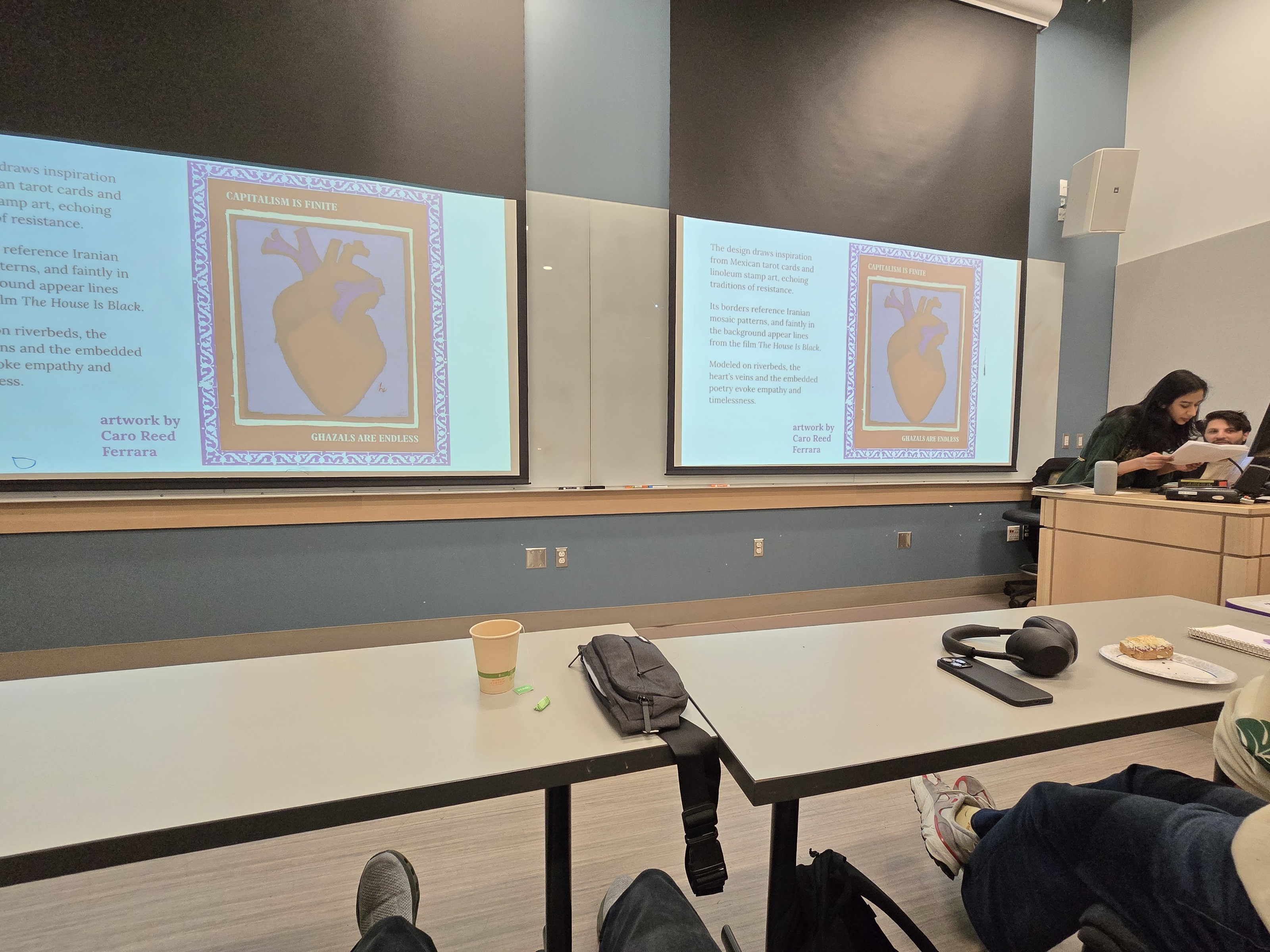
On November 14, 2025 Translation Studies hosted a Ghazal poetry night in Denny 211. The room was so full that some people had to bring chairs from other rooms! The event began with MELC’s Dr. Aria Fani introducing the Translation Studies program and the importance of translations. The attendees enjoyed reading poetry in different original and translated languages: Arabic, Amharic, French, Persian, Russian, Turkish, Urdu, Yiddish, and Korean, to name a few. The poems engaged many themes ranging from passionate love of a lover for their beloved, to a scathing criticism of city life, to addressing cultural prejudices.
For example, one of the poems read at the Ghazal night was by the famous Ethiopian poet Bewketu Seyoum. This poem criticizes political corruption and economic disparity. The title can be translated as “Searching for the Flesh.” It is presented here both in the original Amharic and an English translation.
“እልፍ ከሲታዎች ቀጥነው የሞገጉ ፥
በየሸንተረሩ በየጥጋጥጉ፥
“ስጋችን የት ሄደ?” ብለው ሲፈልጉ ፥
አስሰው አስሰው በምድር በሰማይ፥
አገኙት ቦርጭ ኾኖ ባንድ ሰው ገላ ላይ።
“Legions of gaunt ones, mere skeletons in skin,
Set out to seek the flesh they’d lost.
They combed the hills, they scoured the valleys,
Searched the heavens, searched the earth,
Searched every place where it might hide.
At last they found it—
All of it gathered, swollen and stored, on one man’s big bulging belly.”
The Middle East Center
On December 1, 2025, the Middle East Center organized a Town Hall with Washington State legislators, in order to bring students together with elected officials to discuss the needs of Middle Eastern and North African communities. Thomson 317 was filled to capacity, with a line extending out the door. Over the course of two hours, students, faculty, and community members engaged an energetic panel of lawmakers on topics ranging from ICE’s impact on migrant communities to the persistent underfunding of higher education in Washington State. The legislators committed to returning for a follow-up event in the spring to lead workshops for students about pathways to advocacy in Olympia.
MEC also has an exciting series of events this year, beginning with an immersive, all‑day program on January 23, 2026 dedicated to Palestine. The day will feature film screenings, dynamic panels, and hands‑on workshops. Guests include academics who have faced censorship for speaking out against Israeli state violence, instructors leading sessions on the Palestinian art of embroidery, and a special screening of documentary The Palestine Exception.
On February 6, 2026, MEC welcomed Dr. Shir Alon of the University of Minnesota, who is a scholar of modern Middle Eastern literature and culture and the author of Static Forms: Writing the Present in the Modern Middle East. Dr. Alon’s work explores aesthetics, temporality, and political imagination in contemporary Arabic and Hebrew literature. She also delivered a public lecture and led a graduate seminar focused on part of her book, offering students a rare opportunity to engage closely with a leading voice in Middle Eastern literary studies.
The series continues on May 8, 2026 with the Annual Ayşenur Ezgi Eygi Memorial Lecture, featuring Huda Al‑Marashi, acclaimed author of Homeland: My Father Dreams of Palestine. Al‑Marashi is known for her deeply personal and historically grounded writing on identity, displacement, and intergenerational memory within the Palestinian and Iraqi diasporas. Her work has appeared in major literary outlets, and she is widely recognized for her contributions to Arab American storytelling. Her lecture will bring a powerful blend of memoir, history, and cultural reflection.