
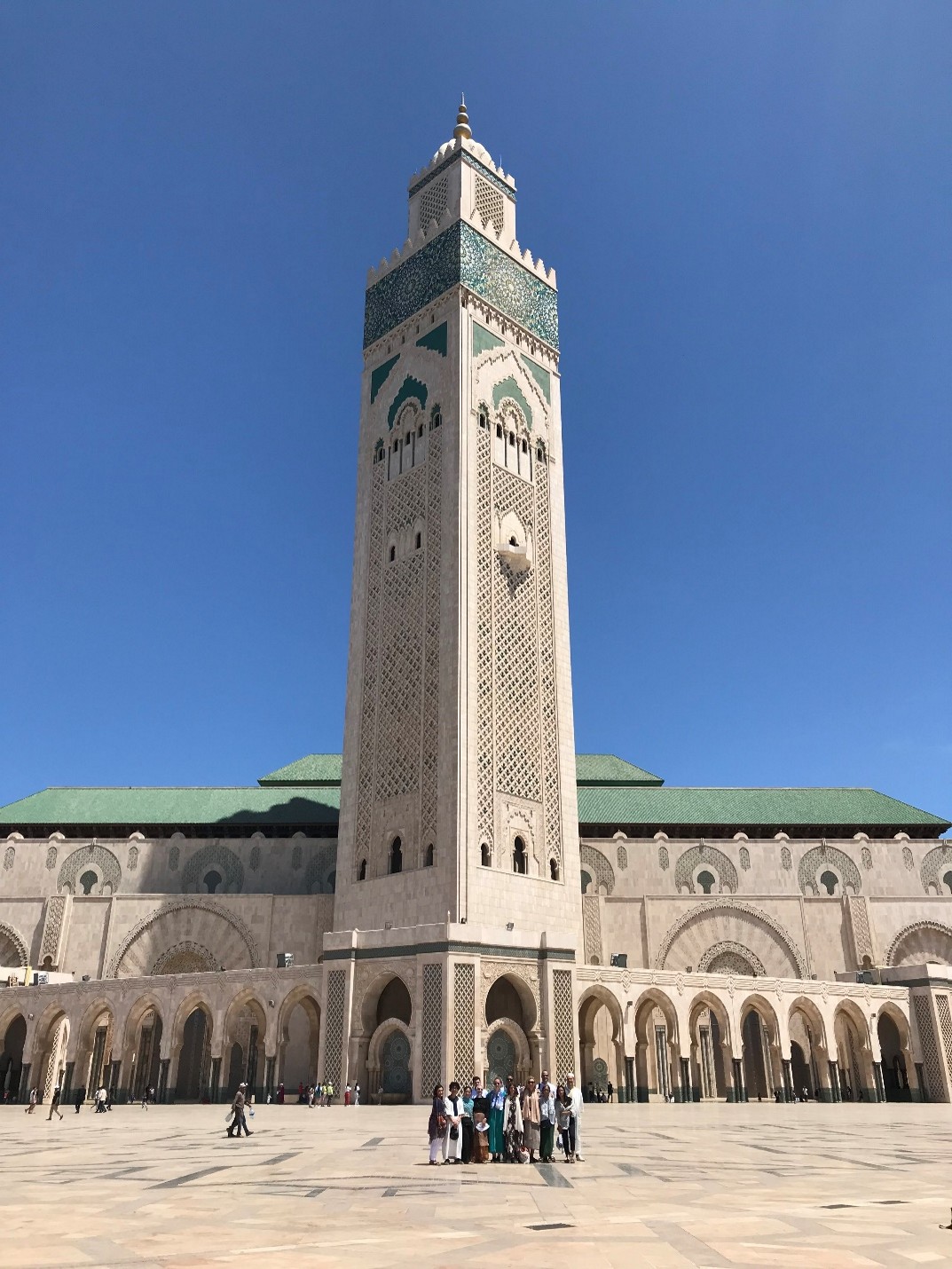
By Kathryn Medill and Mehari Worku
Our Arabic and Islamic Studies offerings continue to grow. We now have a third year of the Arabic language available (ARAB 301, 302, 303), giving UW students more access to Arabic learning than at most other universities! Students with advanced Arabic knowledge can also take special courses this spring quarter like “Introduction to Classical Arabic” (ARAB 412) and “Modern Arabic Poetry” (ARAB 405).
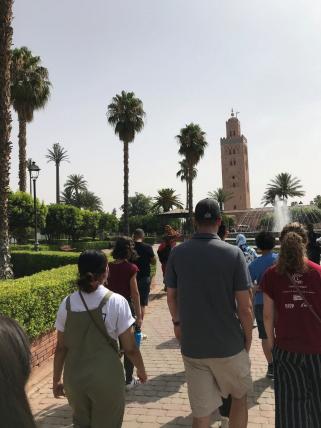
Amina Moujtahid is preparing to lead a second summer of Study Abroad in Rabat, Morocco in August and September 2026. Students will be immersed in Arabic language and culture, gaining experiences that no classroom course can provide. Students will also have a chance to visit local attractions and cultural sites, like the medieval cities of Fez and Marrakech. If you’ve studied Arabic for a year, you are eligible! Find more information in the UW Study Abroad database here (link: Programs > Study Abroad). Students can use their financial aid for this opportunity, or apply for one of our MELC Fellowships (link: MELC Fellowships | Middle Eastern Languages and Cultures | University of Washington).
Students interested in Arabic and Islamic Studies have numerous options for upcoming courses. Lillian McCabe created a new course on “Islam and Science” (Winter 2026), which not only explores the crucial contributions that Islamic scholars past and present have made to mathematics, science, and more; but also the ways that these scholars have thought about knowledge. In Spring 2026, she’ll be teaching “Introduction to Muslim Beliefs and Practices” (MELC 230), a great course for anyone who is curious about modern Islam. Also coming up in spring are Hussein Elkhafaifi’s “Culture of the Arab World” (MELC 334) and Terri DeYoung’s “Thousand and One Nights” (MELC 331), which examines the Arabian Nights in its social and historical contexts.
Arabic and Islamic Studies has also been active in presenting. On November 8, Lillian McCabe presented a talk titled “Translating Enchantment: Journeys of Fakhr al-Dīn al-Rāzī’s (d. 1210) Book of the Hidden Secret,” based on her award-winning dissertation. The Book of the Hidden Secret was an immensely popular text of theoretical and practical magic written by the famed Muslim theologian and philosopher Fakhr al-Dīn al-Rāzī. The Book of the Hidden Secret was also a site in which an Islamic theory of comparative religion was developed. Dr. McCabe explained how al-Rāzī, a renowned Sunni Muslim theologian and philosopher, presented magic—specifically astral magic and talisman making—as a legitimate science in which the human soul could connect with planetary spheres to draw down their powers. The talk explored what this work and its translations can tell us about the relationship between religion and magic in Islamic thought, as—for example—certain sections had to be kept in Arabic in order to stay efficacious, or some sections could not be included in some of the translations due to cultural mores. It was fascinating to see how the Christian Lord’s Prayer in the Syriac language was transliterated into Arabic and considered as a text of enchantment: a fundamental prayer in one religion was transformed into a more-broadly-applicable magical text.